AI makes it surprisingly easy to build a small tool around the way you work. But what happens to your notes when that tool disappears?
I wanted a visual workspace for product research: somewhere to arrange interview notes, connect evidence, and shape a decision. A custom canvas could fit that workflow. I did not want its data trapped inside a custom app.
What is JSON Canvas?
JSON Canvas is an open file format for infinite-canvas data. Obsidian stores its canvases as .canvas files in this format. It records cards, files, links, groups, positions, sizes, and connections as readable JSON.
{
  "id": "finding-4",
  "type": "text",
  "text": "Customers need context before a recommendation.",
  "x": 640, "y": 220,
  "width": 280, "height": 120
}
The format provides enough of a foundation to build around. The app can provide the interactions and visual style; the document remains understandable outside it.
Does the same file open in another app?
I built Fieldnotes Canvas around the format, then opened its sample file in Obsidian. The same cards, groups, positions, and connections appeared in both.
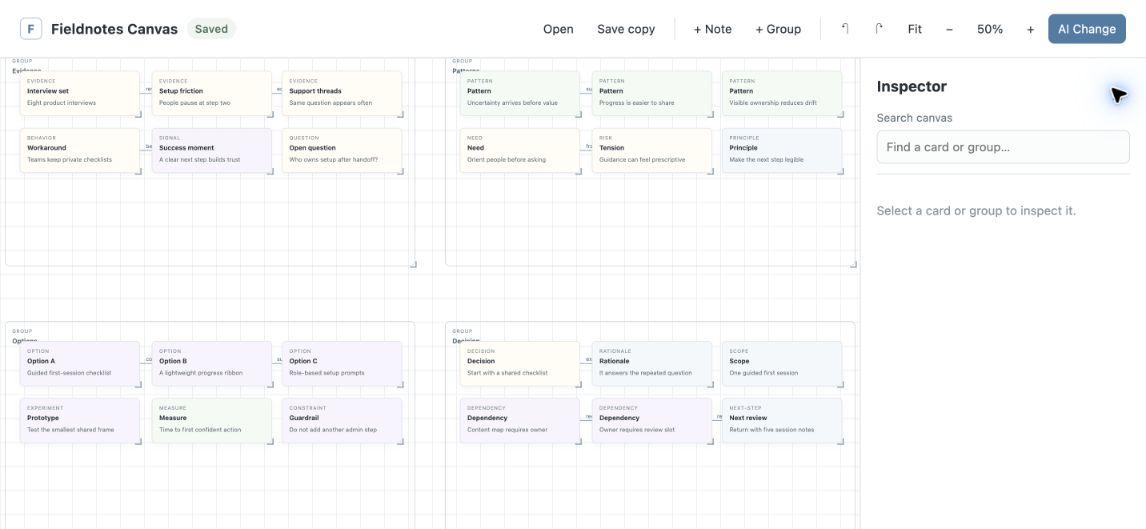
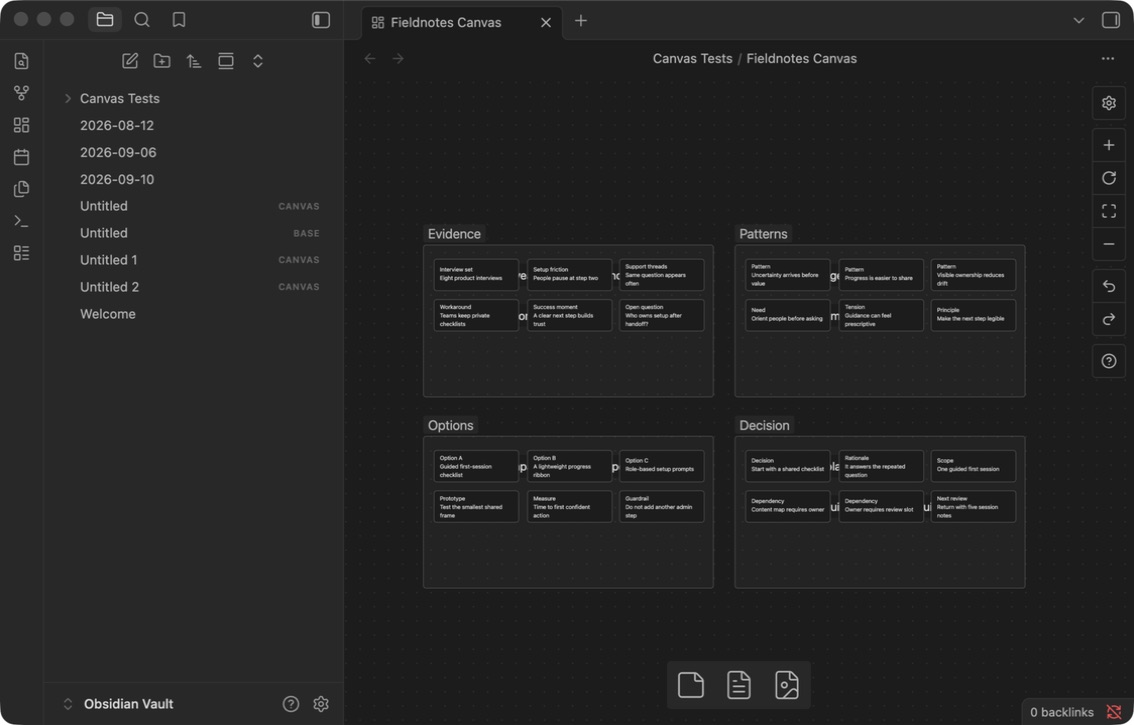
The applications look different. The document structure survives the move.
The controls and visual style change. The cards, groups, positions, and connections remain.
Shared data does not make every app identical. It makes the useful part of the work outlive either one.
Can AI build one for your own work?
The working example is a plain HTML, CSS, and JavaScript app with import and export for JSON Canvas files.
I am also sharing a detailed build brief for creating a standalone app from an empty directory. Change the purpose, groups, cards, and colors, then give it to Claude, ChatGPT, or Codex as a starting point for your own canvas.
Personal software can be temporary. Your work should remain portable.
In Part 2, I look at what an AI actually needs to understand and safely change a spatial document.