Chat is how I ask an AI to do something. A canvas is a different interface: a shared surface that both of us can read and change. I ran one test to see what that makes possible.
Part 2 asked how much of a board an AI has to read before it can safely change one card. This run was the next step. I handed the AI a product journey and let it work. It mapped three ways to start a Quick RFQ (a request for supplier quotes), connected them to the downstream flow, and captured screenshots as it moved through the product. It ran for about four and a half hours and used 1.64 million tokens. Nobody clicked through the product by hand.
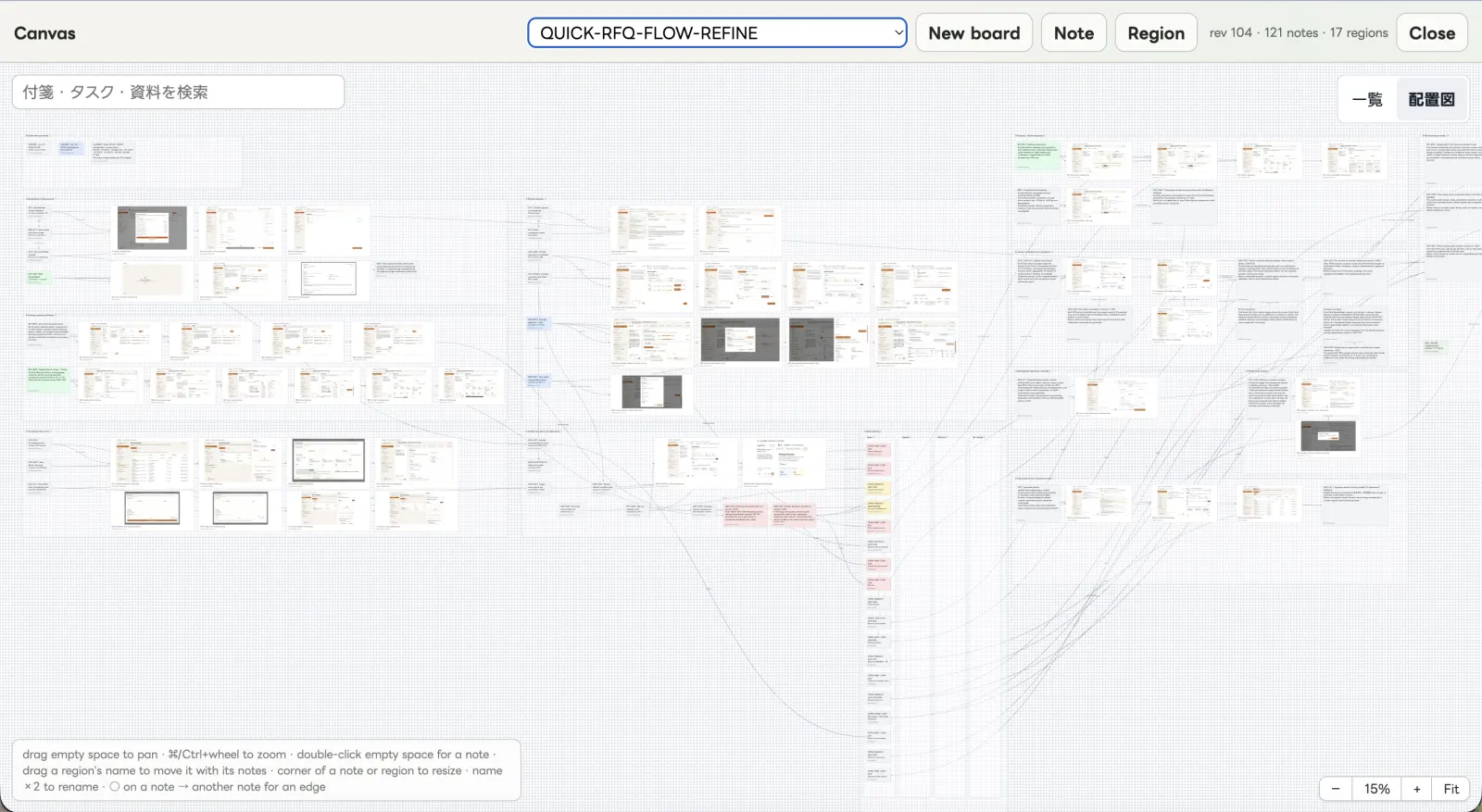
The pass documented everything it was asked to: 98 interactions and outcomes, 53 screenshots, and 21 friction points grouped into 18 cards. Those 21 are problems the product still has.
The board became the work surface
The AI dropped each screenshot beside the step it documented, then linked the steps into a journey. At the bottom of the board it built a triage lane: the friction points it ran into became cards, each still tied to the evidence behind it.
The triage lane changes the review after the first pass. A teammate can open a screenshot, drag a card, correct a label, or add a question. The board keeps those edits, so the next pass starts from the updated map.
Several people can review that map at once, without reconstructing it from a transcript or a folder of images.
Chat carries intent, the board carries state
One run doesn’t prove this works everywhere. It did show me a division of labor I can use: I ask for the work in chat, and the AI leaves an editable map of what happened and what still needs attention.
An AI can produce more evidence in one run than anyone will read in a transcript. Where it leaves that evidence decides what the next person can do with it.